
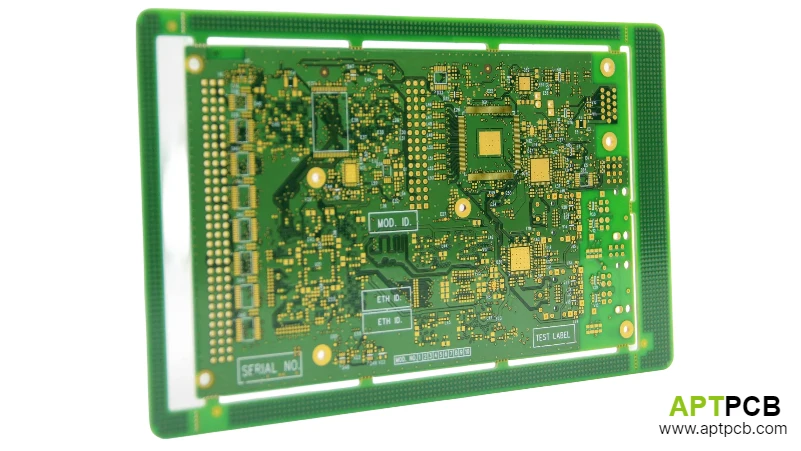
KB-6165F is Kingboard's filled variant of the KB-6165 mid-Tg platform. The addition of inorganic fillers to the phenolic-cured epoxy resin system lowers Z-axis expansion, controls resin flow during lamination, and improves dimensional stability—three attributes that become increasingly critical as layer counts rise above 8. With a typical Tg of 157°C, Td of 346°C, and T-288 exceeding 30 minutes, KB-6165F meets IPC-4101E/99 requirements with substantial margin while keeping material cost well below high-Tg alternatives.
KB-6165F is one of the most widely used mid-Tg laminates globally. Its combination of lead-free assembly compatibility, anti-CAF capability, and competitive pricing through Kingboard's massive manufacturing scale makes it the default choice for cost-conscious multilayer production requiring more than standard FR-4.
In This Guide
- Material System and Construction
- Complete Datasheet Specifications
- Thermal Reliability Deep Dive
- Electrical Properties and Impedance Design
- KB-6065F Prepreg Data
- Lamination Process Parameters
- KB-6165F vs KB-6165 Comparison
- Application Engineering
- Industry Equivalents
- Get Started with APTPCB
KB-6165F Material System: How Inorganic Fillers Improve Reliability
KB-6165F uses a non-DICY (phenolic) cured epoxy resin system with inorganic fillers, reinforced with E-glass fabric. The non-DICY cure mechanism avoids the moisture and nitrogen outgassing associated with dicyandiamide curing agents at elevated temperatures—a key advantage for lead-free reflow processes where peak temperatures reach 245–260°C.
The inorganic filler loading serves three purposes: it constrains Z-axis thermal expansion by adding low-CTE particles to the resin matrix, it restricts resin flow during lamination for more uniform dielectric thickness, and it improves the glass-to-resin interface strength for better anti-CAF performance.
KB-6165F carries UL recognition under file number E123995 and meets IPC-4101E, Slash Sheet /99 specifications. The corresponding prepreg is designated KB-6065F.
KB-6165F Verified Datasheet Specifications from Official Kingboard PDF
All data from Kingboard's official KB-6165F product datasheet. Specimen thickness for typical values: 1.6 mm (8×7628 construction).
Thermal Properties
| Test Item | Test Method | Condition | Spec (IPC-4101E/99) | Typical |
|---|---|---|---|---|
| Thermal Stress | 2.4.13.1 | Float 288°C, Unetched | ≥10 sec | >240 sec |
| Glass Transition (Tg) | 2.4.25 | E-2/105, DSC | ≥150°C | 157°C |
| Z-axis CTE Alpha 1 (below Tg) | 2.4.24 | TMA | ≤60 ppm/°C | 40 ppm/°C |
| Z-axis CTE Alpha 2 (above Tg) | 2.4.24 | TMA | ≤300 ppm/°C | 230 ppm/°C |
| Z-axis Expansion (50–260°C) | 2.4.24 | TMA | ≤3.5% | 3.0% |
| X/Y CTE | 2.4.24 | 40–125°C | — | 12/15 ppm/°C |
| T-260 | 2.4.24.1 | TMA | ≥30 min | >60 min |
| T-288 | 2.4.24.1 | TMA | ≥5 min | >30 min |
| Td (5% weight loss) | 2.4.24.6 | TGA | ≥325°C | 346°C |
| Flammability | UL94 | E-24/23 | V-0 | V-0 |
Electrical Properties
| Test Item | Test Method | Condition | Spec | Typical |
|---|---|---|---|---|
| Surface Resistivity | 2.5.17.1 | C-96/35/90 | ≥10⁴ MΩ | 2.6×10⁸ MΩ |
| Volume Resistivity | 2.5.17.1 | C-96/35/90 | ≥10⁶ MΩ·cm | 3.4×10⁹ MΩ·cm |
| Dielectric Breakdown | 2.5.6 | D-48/50+D0.5/23 | ≥40 kV | ≥45 kV |
| Dk @ 1 MHz | 2.5.5.2 | Etched, R/C 50% | ≤5.4 | 4.8 |
| Dk @ 1 GHz | 2.5.5.2 | Etched, R/C 50% | — | 4.6 |
| Df @ 1 MHz | 2.5.5.2 | Etched, R/C 50% | ≤0.035 | 0.015 |
| Df @ 1 GHz | 2.5.5.2 | Etched, R/C 50% | — | 0.016 |
| CTI | IEC 60112 | — | — | >175V |
| Arc Resistance | 2.5.1 | D-48/50+D-0.5/23 | ≥60 sec | 127 sec |
Mechanical Properties
| Test Item | Test Method | Condition | Spec | Typical |
|---|---|---|---|---|
| Peel Strength (1 oz) | 2.4.8 | 125°C | ≥0.70 N/mm | 1.3 N/mm |
| Peel Strength (1 oz) | 2.4.8 | Float 288°C/10 sec | ≥1.05 N/mm | 1.5 N/mm |
| Peel Strength (1 oz) | 2.4.8 | After Process Solution | ≥0.80 N/mm | 1.1 N/mm |
| Flexural Strength (MD) | 2.4.4 | — | ≥415 N/mm² | 540 N/mm² |
| Flexural Strength (XD) | 2.4.4 | — | ≥345 N/mm² | 480 N/mm² |
| Moisture Absorption | 2.6.2.1 | D-24/23 | ≤0.5% | 0.10% |
Thermal Reliability Analysis: T-260 >60 min and Z-CTE 3.0% Performance
The key differentiation of KB-6165F against standard FR-4 and even unfilled mid-Tg materials lies in the cumulative thermal performance. The T-260 value of >60 minutes is particularly important for complex assemblies requiring multiple soldering operations. A typical double-sided SMT board might see 2 reflow passes (top and bottom components), selective wave soldering for through-hole parts, and potential rework—each exposing the board to temperatures near 260°C.
With T-260 >60 minutes, KB-6165F provides effectively unlimited margin for standard assembly processes. Even boards requiring 10+ reflow passes (such as sequential assembly of multiple sub-assemblies) remain well within safe thermal budgets.
The interplay between Tg and Z-axis CTE deserves careful analysis. Below Tg (157°C), the Z-axis CTE is 40 ppm/°C. Above Tg, it increases to 230 ppm/°C—nearly 6× higher. This is why the total Z-expansion value (3.0% from 50–260°C) is the most critical number for via reliability: it captures the combined effect of both CTE regimes through the full temperature range experienced during reflow.
Electrical Properties and Impedance Design with Filled Resin Systems
KB-6165F's Dk of 4.6 at 1 GHz and Df of 0.016 at 1 GHz are functionally identical to KB-6167F—the filled resin systems in both materials produce very similar dielectric properties. This means impedance calculations, stackup designs, and signal integrity simulations are interchangeable between the two materials.
For a typical 50Ω single-ended microstrip on 4 mil dielectric (2116 prepreg, Dk 4.5), the trace width calculates to approximately 7.2 mil. For 100Ω differential pairs with 5 mil spacing, trace width is approximately 4.5 mil. Our impedance design tools use the prepreg-specific Dk values from the table below for accurate results.
KB-6065F Prepreg System: Dk/Df Data by Glass Style at 1 GHz
| Glass Style | R/C (%) | Dk @ 1 GHz (±0.2) | Df @ 1 GHz (±10%) | Pressed Thickness (mil) |
|---|---|---|---|---|
| 1037 | 74±2 | 4.0 | 0.017 | 2.0±0.30 |
| 1037 | 76±2 | 4.0 | 0.017 | 2.1±0.30 |
| 106 | 70±2 | 4.1 | 0.017 | 1.9±0.30 |
| 106 | 73±2 | 4.0 | 0.017 | 2.2±0.40 |
| 106 | 75±2 | 3.9 | 0.018 | 2.3±0.40 |
| 1080 | 62±2 | 4.3 | 0.016 | 2.8±0.30 |
| 1080 | 65±2 | 4.2 | 0.017 | 3.1±0.40 |
| 1080 | 68±2 | 4.2 | 0.017 | 3.4±0.40 |
| 2116 | 52±2 | 4.5 | 0.016 | 4.6±0.40 |
| 2116 | 55±2 | 4.5 | 0.016 | 5.0±0.40 |
| 2116 | 58±2 | 4.4 | 0.016 | 5.4±0.50 |
| 3313 | 52±2 | 4.5 | 0.015 | 3.5±0.30 |
| 3313 | 55±2 | 4.4 | 0.015 | 3.8±0.30 |
| 3313 | 58±2 | 4.4 | 0.016 | 4.2±0.40 |
| 7628 | 43±2 | 4.7 | 0.015 | 7.3±0.40 |
| 7628 | 45±2 | 4.6 | 0.015 | 7.7±0.50 |
| 7628 | 48±2 | 4.6 | 0.016 | 8.3±0.50 |
This data is directly from Kingboard's official datasheet. The Dk tolerance of ±0.2 and Df tolerance of ±10% should be factored into worst-case impedance calculations.
Lamination Process Parameters and Manufacturing Guidelines
Kingboard's recommended press cycle for KB-6065F prepreg:
- Heat-up rate: 1.5–2.5°C/min (80°C–140°C range)
- Curing temperature: >180°C (lower than KB-6167F's >190°C)
- Curing time: >60 minutes at cure temperature
- Curing pressure: 350±50 PSI (vacuum hydraulic press)
At APTPCB, our multilayer fabrication line uses dedicated press programs for KB-6165F that have been validated through microsection analysis and peel strength testing. Full vacuum is applied throughout the cycle to prevent voiding—particularly important in thin prepreg constructions (1037, 106 glass styles).
Drilling considerations: The filler loading in KB-6165F increases abrasiveness versus unfilled KB-6165. Entry material and backup board selection must account for this. Typical drill hit counts are 15–20% lower than unfilled alternatives. For HDI structures with microvias, UV or CO₂ laser drilling is unaffected by fillers.
KB-6165F vs KB-6165 Unfilled: Detailed Technical Comparison
| Property | KB-6165F (Filled) | KB-6165 (Unfilled) | Significance |
|---|---|---|---|
| Tg (DSC typical) | 157°C | 153°C | Minimal difference |
| Td (TGA typical) | 346°C | 335°C | Better thermal ceiling |
| T-260 (typical) | >60 min | 50 min | Better endurance |
| T-288 (typical) | >30 min | 23 min | Significantly better |
| Z-CTE Alpha 1 | 40 ppm/°C | 55 ppm/°C | 27% lower—major |
| Z-CTE 50–260°C | 3.0% | 3.1% | Modest improvement |
| Dk @ 1 GHz | 4.6 | 4.5 | Slight increase from fillers |
| Df @ 1 GHz | 0.016 | 0.016 | No change |
| Moisture Absorption | 0.10% | 0.30% | 67% lower |
| IPC Slash Sheet | /99 | /124 | Different specs |
| Drill tool life | Lower (15–20%) | Standard | Cost trade-off |
The most significant improvement is the Alpha 1 Z-CTE: 40 vs 55 ppm/°C. Below Tg, where the board spends most of its operating life, this 27% reduction in expansion rate directly extends thermal cycling life.
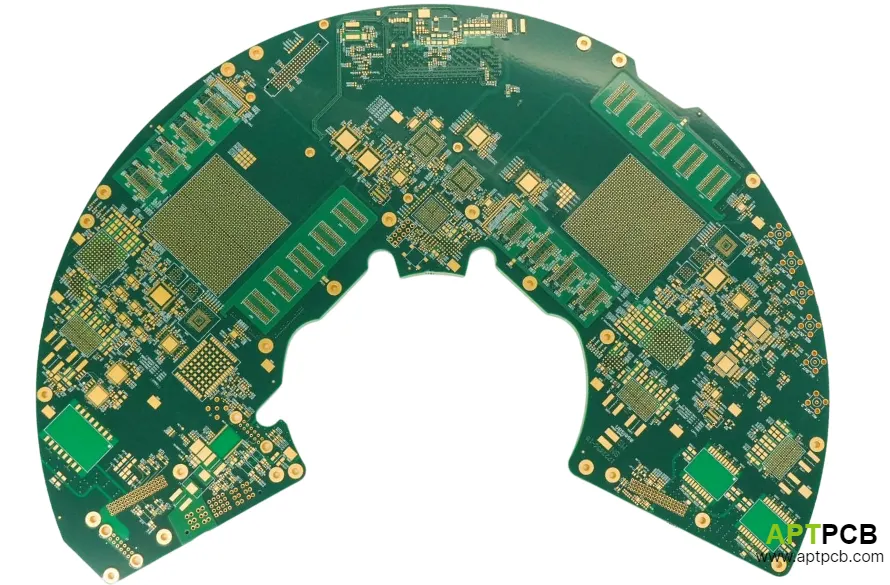
Target Applications: Telecom Infrastructure and Industrial Equipment
High Layer Count Multilayer (10–20 layers): Controlled resin flow maintains uniform dielectric thickness across prepreg layers, keeping impedance within ±7% tolerance even on 16-layer constructions. Innerlayer registration benefits from improved dimensional stability.
Fine-Pitch BGA and µBGA Substrates: Via-in-pad designs with resin plugging and planarization require consistent resin fill quality. The filled system's controlled flow characteristics produce more uniform fill results.
Automotive Body Electronics: Climate control modules, lighting controllers, and infotainment processing boards operating to 105°C ambient. APTPCB's automotive PCB services include KB-6165F with full material traceability.
Telecom and Networking: Switching and routing boards for telecom infrastructure where 10-year service life and lead-free assembly are standard requirements.
Industry Cross-Reference: KB-6165F vs Shengyi S1000-2M and Isola IS415
| Parameter | KB-6165F | Shengyi S1000H | ITEQ IT-158 | Isola IS415 |
|---|---|---|---|---|
| Tg (DSC) | 157°C | 150°C | 150°C | 150°C |
| Dk @ 1 GHz | 4.6 | 4.4 | 4.4 | 4.4 |
| Df @ 1 GHz | 0.016 | 0.016 | 0.016 | 0.013 |
| Z-CTE (50–260°C) | 3.0% | 2.8% | 2.8% | 3.0% |
| IPC Slash Sheet | /99 | /99 | /99 | /99 |
APTPCB processes all major brands and provides material equivalence recommendations during DFM review. For projects requiring lowest cost, we evaluate available inventory across brands.
How to Order KB-6165F PCBs from APTPCB
Upload your Gerber files and stackup specification for a free DFM review including material verification, impedance simulation with prepreg-specific Dk values, and competitive pricing. For complete one-stop PCB fabrication and assembly, we quote both services together for optimized lead time. Mass production runs benefit from dedicated KB-6165F inventory at APTPCB.