
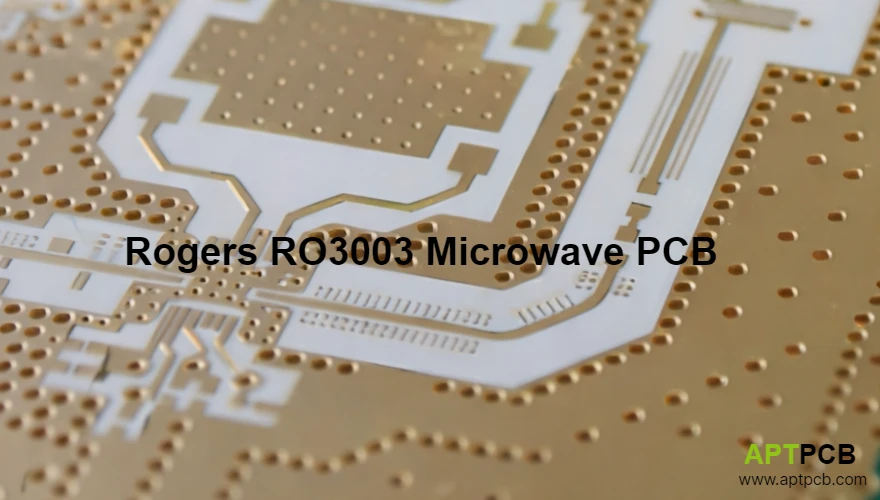
Choosing a microwave PCB material is a system-level decision. The substrate affects transmission-line dimensions, insertion loss, filter stability, antenna performance, thermal behavior, manufacturing yield, and long-term frequency accuracy.
Rogers RO3003 is a ceramic-filled PTFE laminate designed for high-frequency circuits requiring predictable dielectric performance. It provides a process dielectric constant of Dk 3.00 ± 0.04 and dissipation factor of approximately 0.0010 at 10GHz.
The correct selection question is not whether RO3003 can operate at microwave frequencies. The decision is whether RO3003 provides the lowest technical risk for the required frequency band, RF loss budget, power level, and production volume.
When Should You Select Rogers RO3003 for a Microwave PCB?
RO3003 is commonly selected when a design requires stable dielectric behavior and low signal loss across microwave frequencies.
| Application band | Typical frequency | Why RO3003 is considered |
|---|---|---|
| X-band radar | 8–12GHz | Stable impedance for long RF paths, filters and receiver chains |
| Ku-band satellite and radar | 12–18GHz | Low dielectric loss and phase stability |
| K-band sensing | 18–27GHz | Improved RF consistency compared with standard laminates |
| Ka-band communications | 26.5–40GHz | Low Df and controlled dielectric behavior for tight RF budgets |
RO3003 is especially suitable when:
- RF traces are electrically long.
- Filter frequency accuracy matters.
- Antenna feed networks require predictable phase behavior.
- The design combines microwave and higher-frequency RF functions.
- Manufacturing repeatability is more important than minimum material cost.
What Are the Key Rogers RO3003 Material Properties?
The electrical properties that influence microwave PCB performance include:
| Parameter | Typical value | Design impact |
|---|---|---|
| Dielectric constant (Dk) | 3.00 ±0.04 at 10GHz | Controls wavelength and impedance |
| Dissipation factor (Df) | 0.0010 at 10GHz | Determines dielectric loss |
| Thermal coefficient of Dk | −3 ppm/°C | Supports frequency stability |
| Thermal conductivity | 0.50 W/m/K | Requires copper-based thermal paths |
| Moisture absorption | 0.04% | Reduces environmental variation |
The low thermal coefficient of Dk is important for microwave filters and resonators because dielectric variation changes electrical length and can shift operating frequency.
How Do You Select an RO3003 Stackup for 50Ω Transmission Lines?
A controlled impedance design begins with the stackup, not the routing.
The final impedance depends on:
- Dielectric thickness.
- Copper thickness.
- Copper roughness.
- Etch compensation.
- Surface finish.
- Manufacturing tolerance.
Typical RO3003 microstrip references:
| Core thickness | Approximate 50Ω trace width | Typical application |
|---|---|---|
| 10 mil (0.254mm) | ~9–11 mil | Ka-band and high-frequency RF |
| 20 mil (0.508mm) | ~18–22 mil | Ku-band and microwave designs |
| 30 mil (0.762mm) | ~27–32 mil | X-band designs |
| 60 mil (1.524mm) | ~55–65 mil | Lower-frequency RF and higher-power layouts |
Simulation should be followed by manufactured test coupons and impedance verification.
What Is the RO3003 Microwave PCB Loss Budget From X-Band to Ka-Band?
At microwave frequencies, insertion loss directly affects system performance.
| Frequency | Band | Approximate dielectric loss |
|---|---|---|
| 10GHz | X-band | ~0.040 dB/inch |
| 18GHz | Ku-band | ~0.072 dB/inch |
| 28GHz | K-band | ~0.112 dB/inch |
| 38GHz | Ka-band | ~0.152 dB/inch |
Total insertion loss also includes conductor loss. Copper surface roughness becomes increasingly important as frequency rises because current flows near the conductor surface.
For Ka-band designs, low-profile copper is commonly required because standard rough copper can significantly increase conductor loss.
How Does RO3003 Compare With Other Microwave PCB Materials?
| Material choice | Strength | Limitation |
|---|---|---|
| FR-4 | Low cost and easy processing | Higher dielectric loss at microwave frequencies |
| Rogers RO4003C | Easier fabrication with good RF performance | Higher loss than RO3003 |
| Rogers RO4350B | Cost-effective microwave laminate | Higher Df and different temperature behavior |
| RO3003 | Low loss and stable dielectric properties | Requires specialized PTFE processing |
Material selection should follow the RF requirement. A short X-band connection may not require RO3003, while a precision filter, phased-array feed network, or satellite RF chain often benefits from it.
What Are the Common RO3003 Microwave PCB Failure Modes?
| Failure mode | Root cause | Prevention method |
|---|---|---|
| Incorrect impedance | Incorrect stackup assumptions or fabrication variation | Controlled impedance coupons and verified stackup |
| Filter frequency shift | Dk variation or dimensional changes | EM simulation and VNA validation |
| Excess insertion loss | Copper roughness or unsuitable finish | Specify appropriate copper profile |
| Plating defects | Incorrect PTFE processing | Qualified drilling and hole treatment |
| Connector reflection | Poor launch geometry | Model connector transitions before fabrication |
RO3003 performance depends on the complete manufacturing process, not only laminate selection.
How Should Microwave Filters Be Designed on RO3003?
RO3003 supports distributed microwave filters because its low dielectric loss helps preserve resonator quality factor.
Key design benefits include:
- Lower dielectric loss for improved filter efficiency.
- Stable Dk for repeatable resonant frequency.
- Consistent electrical length across production batches.
For narrow-band filters, validate fabricated boards using S-parameter measurements. TDR confirms impedance behavior, while VNA testing confirms actual RF performance.
How Should RO3003 Microwave Power PCB Designs Handle Thermal Management?
RO3003 thermal conductivity is approximately 0.50 W/m/K, so the laminate should not be treated as the main heat-spreading structure for high-power microwave circuits.
Power amplifier and radar transmitter designs typically require:
- Copper via arrays beneath thermal pads.
- Thermal connections to chassis or heat spreaders.
- Thermal simulation for pulsed radar loads.
Heat removal depends primarily on copper structures and mechanical integration.
Which Connectors Match RO3003 Microwave PCB Designs?
| Connector | Frequency range | Typical usage |
|---|---|---|
| SMA | DC–18GHz | X-band evaluation and lower microwave designs |
| 2.92mm K connector | DC–40GHz | Ku, K and Ka-band production designs |
| 2.4mm connector | DC–50GHz | Higher-frequency measurement systems |
Connector launch geometry must match the RO3003 stackup. Incorrect pin height or transition geometry creates return-loss problems.
What Fabrication Requirements Should Be Specified for RO3003 PCB Manufacturing?
RO3003 requires processes different from standard FR-4 fabrication.
A qualified manufacturer should demonstrate:
- PTFE-compatible drilling.
- Plasma or chemical hole-wall treatment.
- Controlled lamination processes.
- RF impedance capability.
- Material traceability.
The RO3003 PCB fabrication process guide covers manufacturing requirements for PTFE-based RF production.
What Should Be Included in an RO3003 PCB Supplier Checklist?
| Qualification item | Required evidence |
|---|---|
| RO3003 experience | Previous microwave production examples |
| Material control | Rogers material traceability |
| Impedance capability | Coupon reports and measured data |
| RF validation | TDR and VNA capability |
| Quality control | Inspection records and process documentation |
| Production scaling | Prototype-to-volume manufacturing plan |
How Do You Move From RO3003 Prototype to Production?
A reliable production path includes:
- Define frequency band and RF loss target.
- Select RO3003 thickness and copper configuration.
- Complete electromagnetic simulation.
- Confirm the final stackup with the manufacturer.
- Build first articles.
- Validate impedance and S-parameters.
- Establish production controls.
The RO3003 PCB supplier guide explains supplier selection considerations including prototype planning and manufacturing capability.
The RO3003 PCB manufacturer qualification guide covers certifications, equipment requirements, and documentation expectations.
Final Decision: Is Rogers RO3003 the Right Microwave PCB Material?
Rogers RO3003 is a strong choice when microwave performance depends on low loss, stable dielectric properties, and repeatable RF manufacturing.
For X-band radar, Ku-band satellite links, K-band sensing, and Ka-band communication systems, RO3003 provides:
- Low dielectric loss.
- Stable frequency behavior.
- Predictable impedance.
- Production repeatability.
The final RF performance depends on the entire design chain: laminate selection, stackup construction, copper specification, connector transition, fabrication process, and validation method.