
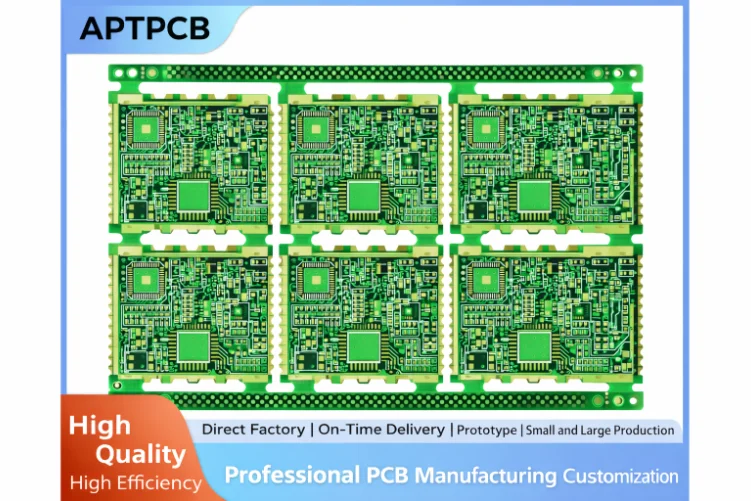
KB-6164 is a lead-free compatible normal-Tg FR-4 laminate designed for multilayer PCB applications that require improved thermal reliability, lower Z-axis expansion, and anti-CAF performance without moving to higher-cost mid-Tg or high-Tg materials.
For many PCB designs, the material decision is not simply “highest Tg wins.” Lead-free assembly reliability depends on several interacting properties: Z-axis CTE, thermal decomposition resistance, moisture absorption, plated-through-hole reliability, and electrochemical stability.
KB-6164 addresses these requirements with a filled phenolic-cured epoxy system featuring:
- Tg of approximately 140°C (DSC)
- Z-axis expansion of approximately 3.5% from 50–260°C
- Z-axis CTE Alpha 1 of approximately 45 ppm/°C
- T-260 greater than 60 minutes
- Anti-CAF capability
- KB-6064 prepreg compatibility
This makes KB-6164 a strong candidate for cost-sensitive multilayer boards requiring more reliability margin than conventional FR-4.
Is KB-6164 the right PCB material for my application?
The best use case for KB-6164 is a multilayer PCB that needs reliable lead-free assembly but does not require the extreme thermal performance of high-Tg materials.
| Design requirement | KB-6164 suitability | Engineering reason |
|---|---|---|
| Lead-free reflow assembly | Excellent | T-260 >60 minutes and strong thermal stress performance |
| Dense via fields | Excellent | Lower Z-axis expansion reduces via barrel strain |
| Fine-pitch BGA designs | Good | Anti-CAF capability improves electrochemical reliability margin |
| Cost-sensitive multilayer PCB | Excellent | Higher reliability than standard FR-4 without high-Tg pricing |
| Very high-temperature operation | Limited | Consider higher Tg materials |
| Extremely high layer count | Evaluate | Stackup thickness and via aspect ratio become critical |
What makes KB-6164 different from standard FR-4?
The main reliability advantage of KB-6164 is controlled Z-axis expansion.
During lead-free assembly, PCB temperatures can approach 260°C. The laminate expands through the thickness direction, placing mechanical stress on plated copper vias. Repeated thermal cycles can eventually create barrel cracks and intermittent electrical failures.
The critical property for this failure mechanism is not only Tg. Z-axis CTE determines how much mechanical movement the copper structure experiences.
| Material | Tg (DSC) | Z-CTE 50–260°C | Z-CTE Alpha 1 |
|---|---|---|---|
| KB-6160 | 135°C | 4.3% | 60 ppm/°C |
| KB-6164 | 140°C | 3.5% | 45 ppm/°C |
| KB-6165 | 153°C | 3.1% | 55 ppm/°C |
| KB-6167F | 175°C | 2.6% | 40 ppm/°C |
KB-6164 reduces Z-axis expansion compared with KB-6160 while maintaining a normal-Tg processing profile. The filled resin system improves dimensional stability and reduces thermal strain on interconnect structures.
What are the KB-6164 PCB material specifications?
KB-6164 is specified for lead-free FR-4 applications under IPC-4101E/101 requirements. Typical values include:
| Test Item | Test Method | Typical Value |
|---|---|---|
| Glass Transition (Tg) | IPC-TM-650 2.4.25 DSC | 140°C |
| Z-axis CTE Alpha 1 | IPC-TM-650 2.4.24 TMA | 45 ppm/°C |
| Z-axis CTE Alpha 2 | IPC-TM-650 2.4.24 TMA | 240 ppm/°C |
| Z-axis Expansion 50–260°C | IPC-TM-650 2.4.24 | 3.5% |
| T-260 | IPC-TM-650 2.4.24.1 | >60 min |
| T-288 | IPC-TM-650 2.4.24.1 | >15 min |
| Td (5% weight loss) | IPC-TM-650 2.4.24.6 | 330°C |
| Flammability | UL94 | V-0 |
Electrical properties
| Test Item | Typical Value |
|---|---|
| Dk @ 1 GHz | 4.6 |
| Df @ 1 GHz | 0.016 |
| Surface Resistivity | 2.2×10⁸ MΩ |
| Volume Resistivity | 3.1×10⁹ MΩ·cm |
| Dielectric Breakdown | ≥45 kV |
| CTI | ≥175V |
Mechanical properties
| Test Item | Typical Value |
|---|---|
| Peel Strength (1 oz.) | 1.60 N/mm |
| Flexural Strength MD | 550 N/mm² |
| Flexural Strength XD | 496 N/mm² |
| Moisture Absorption | 0.10% |
How does KB-6164 improve via reliability?
KB-6164 improves plated-through-hole reliability through lower Z-axis movement and stronger thermal endurance.
| Failure mechanism | Material factor | KB-6164 contribution |
|---|---|---|
| Via barrel cracking | Excessive Z-axis expansion | 3.5% Z-axis expansion reduces strain |
| Reflow delamination | Thermal decomposition | T-260 >60 minutes provides margin |
| Moisture-related defects | Water absorption | 0.10% typical moisture absorption |
| CAF shorts | Glass/resin interface degradation | Anti-CAF formulation improves reliability |
CAF occurs when conductive copper filaments grow along glass fiber interfaces under moisture and electrical bias conditions. KB-6164 includes anti-CAF capability, making it suitable for dense multilayer designs with tighter via spacing.
What KB-6064 prepreg options are available?
KB-6164 uses the KB-6064 prepreg system. Engineers should use prepreg-specific dielectric values during impedance calculations because resin content and glass style change effective Dk.
| Glass Style | Resin Content | Dk @ 1 GHz | Df @ 1 GHz | Pressed Thickness |
|---|---|---|---|---|
| 106 | 74±2% | 4.1 | 0.017 | 2.1±0.30 mil |
| 1067 | 72±2% | 4.2 | 0.017 | 2.5±0.30 mil |
| 1080 | 65±2% | 4.2 | 0.017 | 3.1±0.40 mil |
| 2116 | 55±2% | 4.5 | 0.016 | 5.0±0.40 mil |
| 1506 | 50±2% | 4.5 | 0.016 | 6.8±0.50 mil |
| 7628 | 45±2% | 4.6 | 0.015 | 7.7±0.50 mil |
The available KB-6064 glass styles provide flexibility for impedance-controlled multilayer stackups, including thinner dielectric constructions using 106 and 1067 styles.
KB-6164 vs KB-6160 vs KB-6165: which material should I choose?
| Parameter | KB-6160 | KB-6164 | KB-6165 | KB-6165F |
|---|---|---|---|---|
| IPC Classification | 4101E/21 | 4101E/101 | 4101B/124 | 4101E/99 |
| Cure Chemistry | DICY | Phenolic filled | Phenolic | Phenolic filled |
| Tg | 135°C | 140°C | 153°C | 157°C |
| Td | 305°C | 330°C | 335°C | 346°C |
| T-260 | Not specified | >60 min | 50 min | >60 min |
| Z-CTE 50–260°C | 4.3% | 3.5% | 3.1% | 3.0% |
| Anti-CAF | No | Yes | Yes | Yes |
| Dk @ 1 GHz | 4.25 | 4.6 | 4.5 | 4.6 |
KB-6164 is positioned between standard FR-4 and higher-performance materials. It provides a practical reliability upgrade without requiring a full transition to high-Tg laminate.
What should PCB suppliers confirm before manufacturing with KB-6164?
A material qualification checklist should include:
| Item to confirm | Required information |
|---|---|
| Laminate grade | KB-6164 |
| Prepreg system | KB-6064 |
| Copper thickness | Final copper weight and foil type |
| Stackup | Layer count and dielectric thickness |
| Impedance control | Use KB-6064 prepreg Dk values |
| Reliability testing | Thermal cycling and via validation requirements |
| Production capability | Filled-material drilling parameters |
Where is KB-6164 commonly used?
KB-6164 is suitable for:
- Consumer electronics
- Computer and notebook products
- Industrial control boards
- Automotive electronics
- Communication equipment
- Multilayer boards requiring improved thermal cycling reliability
For designs above approximately 8:1 via aspect ratio or requiring additional thermal margin, consider upgrading to KB-6165F or KB-6167F.
For stackup planning, use prepreg-specific Dk values from the KB-6064 table and review stackup design guidance.
How does KB-6164 compare with other low-CTE FR-4 materials?
KB-6164 competes in the enhanced standard-Tg FR-4 category.
| Manufacturer | Material | Tg | Z-CTE 50–260°C | Anti-CAF |
|---|---|---|---|---|
| Kingboard | KB-6164 | 140°C | 3.5% | Yes |
| Shengyi | S1141 | 140°C | ~3.8% | Yes |
| ITEQ | IT-140 | 140°C | ~3.5% | Yes |
| Nan Ya | NP-140TL | 140°C | ~3.8% | Yes |
How can I order KB-6164 PCBs?
APTPCB supports KB-6164 multilayer PCB fabrication from prototype through production volumes.
Manufacturing support includes:
- KB-6164 laminate and KB-6064 prepreg availability
- 2-layer through 12-layer PCB fabrication
- Standard and impedance-controlled designs
- PCB prototype orders
- Small-batch production
- Mass production
Upload your Gerber files for DFM review and a KB-6164 material quotation.