
A PCB assembly quote can cover much more than placing components on a bare board. Depending on the agreement, it may include component purchasing, assembly setup, soldering, inspection, testing, documentation and delivery. Two prices are difficult to compare if they include different parts, quantities or acceptance requirements.
The most useful question is not simply “What is the price per board?” It is “What finished product, services and risks does that price cover?”
For a turnkey order, APTPCB’s assembly page identifies variables such as BOM sourcing and availability, board requirements, quantity, tooling, test scope and records. That description is a starting point for a request, not a promise that every service is included in every job. Confirm the scope and terms for your project.
Start with the scope of the populated board
A complete PCBA cost can include:
- Bare PCBs: fabrication, finish, panelization and any board-level requirements.
- Components: purchased parts, customer-supplied parts, approved substitutes and allowances for excess material.
- Assembly conversion: setup and the work needed to populate and solder the boards.
- Inspection and test: agreed checks, fixtures, programs, records and any rework arrangements.
- Other charges: sourcing, packaging, freight, taxes or changes, depending on the quote.
A turnkey price may combine these into one figure, while another supplier may itemize them. Neither format is inherently better. Ask for enough detail to see what is included and what could be billed separately.
Also establish whether the quoted unit is an individual finished board or a panel containing multiple boards. Specify the number of boards per panel and whether depaneling is included. A price per panel cannot be compared directly with a price per board without accounting for those differences.
How quantity affects setup allocation
Assembly often involves order-level work as well as work that varies with the number of boards. Preparing production data, setting up equipment or programming inspection may be charged separately or incorporated into a unit price. The actual structure depends on the supplier and job.
The following example illustrates allocation only. It is hypothetical assembly conversion, not a turnkey price, APTPCB quote or market rate.
Assume one unchanged revision, a fixed setup charge of $600 once per order, plus $3 per board, with no step discounts:
| Order quantity | Setup | Variable conversion total | Total conversion | Conversion per board |
|---|---|---|---|---|
| 100 boards | $600 | 100 × $3 = $300 | $900 | $9.00 |
| 1,000 boards | $600 | 1,000 × $3 = $3,000 | $3,600 | $3.60 |
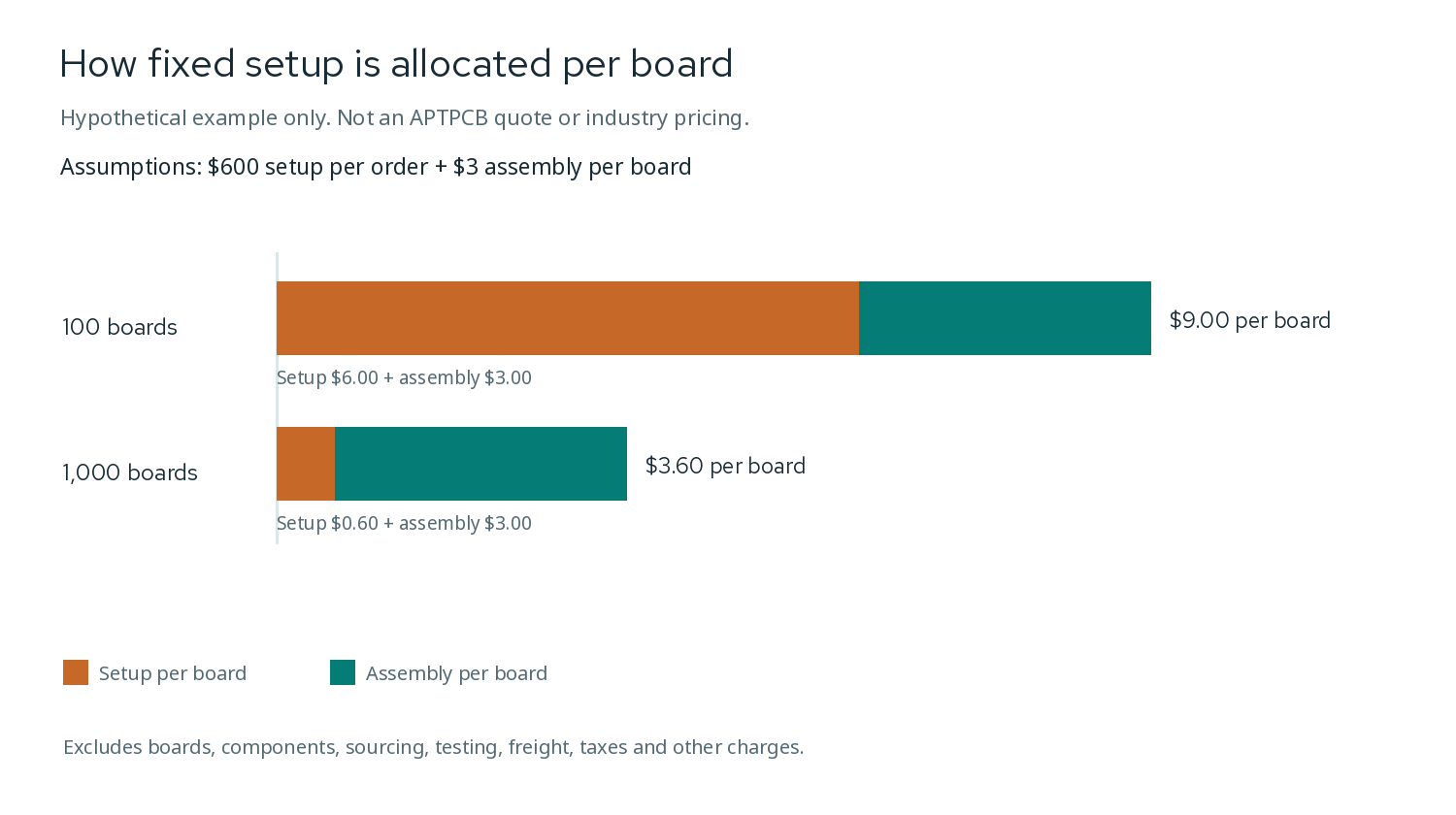
Image assumptions: $600 setup once per order plus $3 per board, one unchanged revision and no step discounts. The comparison holds the other stated variables constant.
This example excludes bare PCBs, components, sourcing, freight, taxes, scrap, repairs, tests, changes, excess components and other fees. Actual setup and variable costs can change with quantity, so the calculation does not prove that a larger order will always have a lower actual unit price.
For a real quote, ask whether setup is charged again for a repeat order or a revised design, and whether tooling or programs can be reused. Also check whether a lower quoted price requires a single delivery or a commitment to purchase more inventory than you need.
The BOM determines more than the parts price
The bill of materials affects both purchasing and assembly planning. A useful comparison starts with the exact BOM revision and the quantity of finished boards required.
BOM lines are not the same as placements
A BOM line identifies a part or group of identical parts. The number of placements is the number of component instances populated on the board. One resistor line might represent many reference designators; another line might represent a single connector.
Ask the assembler to quote against the intended population count, including which parts go on each side of the board. Placement count alone does not describe all assembly work, but it helps prevent a quote based on an incomplete or incorrectly grouped BOM.
Identify variants and DNP parts
Mark do not populate (DNP) positions clearly for each variant. State the quantity of each variant, rather than giving only the total number of boards. A common design file may support several products, but the populated components and setup requirements can differ.
Keep the BOM, assembly drawing and placement data consistent. Include reference designators, quantities per board, manufacturer part numbers and any permitted alternates. The guides to preparing a turnkey assembly BOM and assembly BOM practices cover the information buyers and assemblers need to reconcile.
Account for purchasing quantities and unused parts
Component purchasing does not always match the exact number consumed by finished boards. Minimum order quantities, packaging increments and material needed for the assembly process can affect how many parts must be supplied or purchased.
For each quote, clarify:
- Whether parts are purchased by the assembler, supplied by the customer or split between them.
- Whether the price includes any required excess, and how shortages are handled.
- Who owns unused purchased or customer-supplied parts after the order.
- Whether unused parts will be returned, stored or disposed of, and at whose cost.
- Who approves substitutions and what documentation is required.
APTPCB’s component sourcing page discusses sourcing and approval. For a specific order, agree on the approval process and any associated charges rather than assuming them from the service description.
A lower component price is not the only consideration. Availability, traceability, approved sources and substitution time can affect delivery risk. Those risks may matter even when they do not appear as a separate line item in the quote.
Assembly processes depend on the design
The assembly route is driven by the components, board and requirements. A design may involve surface-mount parts, through-hole parts, components on both sides or parts requiring special handling. The quote should identify relevant process steps rather than applying a single assumed charge to every design.
For example, a QFN or SON package requires attention to the land pattern, stencil, placement, reflow, inspection and possible rework. NXP’s QFN/SON application note discusses these process considerations. It does not establish a universal cost premium for those packages; the commercial effect depends on the design and quoted scope.
Similarly, moisture-sensitive components may need controls for storage, exposure and reflow preparation. Texas Instruments’ guidance on moisture sensitivity and reflow explains the handling considerations, not the fees a supplier will charge.
When reviewing a process-related charge, ask what it covers. Is it a one-time setup, a per-board operation, a material charge or a contingency? If the supplier proposes a design or component change to simplify assembly, involve engineering before accepting it. A saving is useful only if the revised product still meets its electrical, mechanical and reliability requirements.
Inspection and test must be explicit
Do not assume that any particular inspection or test is included. Two quotations can describe boards as “assembled” while providing different levels of verification.
Agree on the method, coverage, acceptance criteria and records. Depending on the design and agreement, the scope might include visual inspection, automated optical inspection, X-ray inspection, electrical checks or functional testing. These methods answer different questions: an inspection of solder joints is not automatically a functional test of the finished product.
For a test requirement, define:
- What the test is intended to verify and which boards will be tested.
- Who supplies and maintains the fixture, program, procedure and limits.
- Whether setup, test execution, data and reports are included.
- How failures, diagnosis, rework and retest will be handled and charged.
- What access, firmware, calibrated equipment or sample units are needed.
If a quote excludes test, compare it with another quote only after accounting for how and where testing will be performed. Reducing inspection or changing acceptance criteria may reduce quoted work, but it can also change the risk accepted by the buyer. Engineering and quality teams should approve such changes.
Compare quotes on an equal basis
Before selecting a supplier, put the quotations against the same request. A short comparison sheet can reveal differences hidden by a single unit price.
| Comparison point | What to confirm |
|---|---|
| Product definition | PCB and BOM revisions, assembly files, variants and DNP positions |
| Quantity and unit | Finished boards or panels, boards per panel, delivery quantity and depaneling |
| Materials | Bare boards and components included or supplied; approved sources and alternates |
| Purchasing | Minimum quantities, excess material, ownership and disposition of unused parts |
| Assembly | Processes covered, tooling, setup and recurring charges |
| Quality | Inspection and test methods, acceptance criteria, records, rework and retest |
| Commercial terms | Freight, taxes, change charges, payment and quote validity |
| Delivery | Assumed material availability, schedule dependencies and how shortages are communicated |
If one quote is lower, identify whether it reflects a genuine difference in price for the same scope or an omitted requirement. Ask for a revised quote or a written clarification where the scopes differ.
Separate cost from delivery risk in that comparison. A part with uncertain availability, for example, may not add a stated fee today but could affect the schedule. Conversely, a clear sourcing or test charge may buy a service you would otherwise need to arrange separately.
Prepare a request that can be quoted
Send the same controlled package to each supplier: manufacturing data for the bare board, the BOM, placement data, assembly drawings, variant instructions, quantities and quality requirements. Identify what you will supply and what you want sourced. Flag critical parts, substitution restrictions, delivery constraints and required test documentation.
For design-stage opportunities, APTPCB’s guides to PCB cost reduction and cost-focused DFM provide related context. For populated-board procurement, use those ideas alongside the actual BOM, assembly and test requirements—not as a substitute for a scope-specific quote.
Request a quote or contact APTPCB to discuss the information and terms needed for your project.