
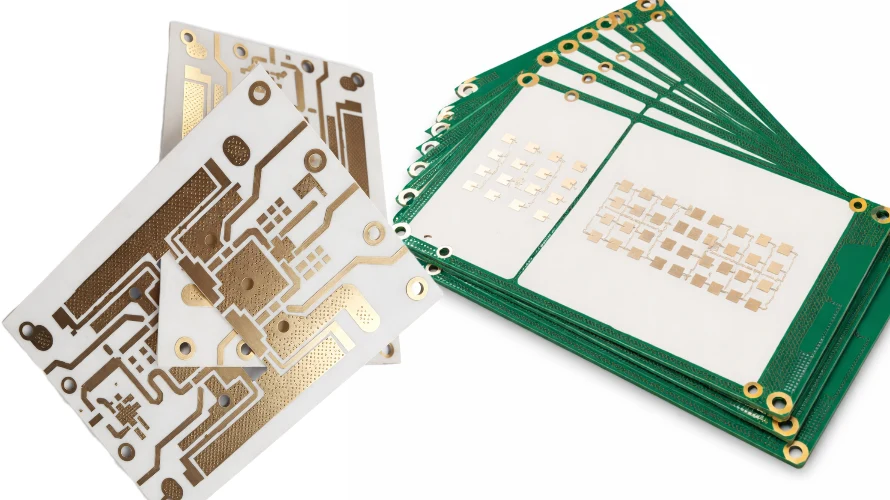
A Rogers circuit board does not fail because the simulation was wrong. It fails because the simulation model and the manufactured structure are different.
For RF and mmWave applications, the critical decisions happen before routing begins: laminate selection, dielectric thickness, copper profile, via architecture, impedance tolerance, and fabrication capability. A 50Ω transmission line in an EM solver only becomes a 50Ω transmission line on hardware when those manufacturing variables are controlled.
This guide provides the engineering decisions required to move from Rogers material selection to production-ready Gerbers for applications including 5G infrastructure, automotive radar, Ka-band satellite systems, E-band links, and phased-array antenna modules.
How do you choose the right Rogers stackup for an RF PCB?
The stackup defines the electromagnetic environment. Before simulation, specify:
- Rogers material grade and measured dielectric properties
- Core thickness and tolerance
- Copper weight and copper foil profile
- Reference plane locations
- Bondply thickness for hybrid constructions
- Via technology requirements
For RO3003 applications, the baseline material properties are Dk 3.00 ± 0.04 at 10 GHz, Df 0.0010, and TcDk −3 ppm/°C. The Rogers RO3003 PCB material specification provides the starting parameters, but high-frequency designs should use frequency-dependent data from Rogers tools or measured characterization.
Rogers stackup decision matrix
| Design requirement | Preferred stackup approach | Primary reason |
|---|---|---|
| Lowest RF loss and maximum phase stability | Full RO3003 construction | Eliminates hybrid dielectric transitions |
| Cost-sensitive RF module | RO3003 RF layers with FR-4 inner layers | Maintains RF performance while reducing material cost |
| Dense phased array routing | Multilayer RF stack with controlled via transitions | Supports matched electrical paths |
| Simple RF feed network | 2-layer or 4-layer RO3003 structure | Reduces fabrication complexity |
Hybrid RO3003/FR-4 designs require accurate modeling of bondply thickness and dielectric properties. The transition between materials becomes part of the RF design, especially above 20 GHz.
What trace width produces 50Ω impedance on RO3003?
Trace width is controlled by dielectric thickness, dielectric constant, copper thickness, and conductor roughness.
Approximate 50Ω microstrip widths for RO3003 with Dk=3.00 and 1 oz copper:
| Core Thickness | ~50Ω Trace Width |
|---|---|
| 5 mil (0.127mm) | ~4–5 mil |
| 10 mil (0.254mm) | ~9–11 mil |
| 20 mil (0.508mm) | ~18–22 mil |
Final dimensions should come from a full-wave EM model or impedance calculator using the actual stackup. Above 30 GHz, dispersion and conductor effects make simplified formulas less reliable.
How much does Rogers thickness tolerance affect impedance?
A nominal stackup is not the same as a manufactured stackup.
For a 10 mil RO3003 core, a ±10% dielectric thickness variation changes the electromagnetic field distribution enough to create approximately ±3–4Ω impedance variation when trace width remains fixed.
| Variable | RF impact |
|---|---|
| Core thickness variation | Changes impedance directly |
| Copper thickness variation | Changes conductor geometry |
| Copper roughness | Changes insertion loss |
| Dk variation | Changes phase velocity |
| Etch variation | Changes trace width |
For impedance requirements tighter than ±10%, fabrication data should be included in the design loop. The fabricator should provide measured core thickness information, controlled impedance capability, and TDR coupon results.
Which copper foil should be specified for mmWave Rogers boards?
At mmWave frequencies, current flows primarily near the conductor surface. Copper roughness increases effective RF path length and conductor loss.
Low-profile ED copper with RMS roughness around 1.5 μm can provide significantly lower conductor loss than standard ED copper with approximately 5–7 μm roughness.
Copper foil selection should be part of the laminate specification, not a post-layout manufacturing decision.
How should via transitions be designed on Rogers PCBs?
A via is an RF component. At high frequencies, it contains inductance, capacitance, and potentially a resonant stub.
A simplified via model includes:
- Barrel inductance: approximately 0.5–1.0 nH for a 0.3mm via in a 10 mil core
- Pad capacitance: approximately 0.05–0.1 pF depending on geometry
- Stub resonance: caused by unused via length below the connected layer
Via transition selection guide
| Via structure | Best fit | Main design consideration |
|---|---|---|
| Through via with optimization | Lower-frequency RF designs | Requires stub analysis |
| Back-drilled via | High-frequency multilayer RF | Removes unused barrel length |
| Blind via | mmWave transitions | Requires PTFE plating control |
| POFV | RFIC thermal pads | Requires fill and planarity control |
Back-drilling removes the non-functional via section below the final connection layer. For high-frequency designs, back-drill depth accuracy around ±50 μm is required.
Blind vias eliminate the unused barrel by terminating at the target layer. For RO3003 structures, blind via aspect ratio is typically constrained around 0.8:1 (diameter:depth) to maintain IPC Class 3 plating reliability.
How should ground vias be placed around RF transitions?
The return current path is part of the transmission line.
Ground vias placed near signal transitions reduce loop area and minimize excess inductance. For mmWave routing above 20 GHz, ground via fences are commonly designed with spacing below λ/4 at the operating frequency.
Every signal via transition should be evaluated together with:
- adjacent ground vias,
- anti-pad geometry,
- reference plane continuity,
- and connector or package launch geometry.
How do Rogers antenna feeds affect system performance?
The antenna feed network directly consumes transmit power and receiver sensitivity. Every unnecessary fraction of a decibel reduces system margin.
Feed design decisions
For phased-array systems:
- Minimize feed path length.
- Match electrical path lengths between antenna elements.
- Maintain consistent dielectric properties across routing layers.
- Model dividers, bends, launches, and vias as RF structures.
RO3003's Dk stability supports phase matching requirements for array systems. Wilkinson dividers and rat-race couplers require accurate impedance control because small dimensional variations accumulate into measurable phase and amplitude imbalance.
How is thermal management handled on RO3003 RF boards?
RO3003 provides excellent RF performance but has low thermal conductivity at approximately 0.50 W/m/K. Heat from RFICs must therefore move through copper structures rather than through the dielectric.
POFV thermal design parameters
| Parameter | Typical value |
|---|---|
| Thermal pad coverage | ≥50% |
| Via diameter | 0.3mm drilled |
| Finished via diameter | 0.25mm after plating |
| Via pitch | 0.6mm |
| Fill | Thermally conductive epoxy |
| Surface planarity | Within ±10 μm |
For a typical 3×3mm RFIC thermal pad using a 3×3 via array, effective thermal resistance is approximately 15–25°C/W depending on attachment conditions.
The RO3003 PCB manufacturing thermal management guide covers the relationship between POFV design, copper structures, and thermal performance.
What RF PCB failures should be checked before fabrication?
| Failure mode | Cause | Design control |
|---|---|---|
| Impedance shift | Incorrect Dk or thickness assumption | Use measured stackup data |
| Poor return loss | Via discontinuity | Simulate via transitions |
| Resonance in operating band | Via stub | Use back-drilling or blind vias |
| Excess insertion loss | Rough copper or long feeds | Specify copper profile and optimize routing |
| Thermal failure | Insufficient copper path | Design POFV arrays early |
What should a Rogers PCB supplier provide before production?
A qualified RF PCB supplier should support:
- Controlled impedance documentation
- TDR coupon measurement
- Stackup confirmation
- Copper roughness data
- Microsection inspection
- Via reliability documentation
- LDI and etch compensation capability
The RO3003 custom PCB engineering guide explains how stackup development, impedance control, and DFM reviews are integrated for production RF boards.
The RO3003 PCB manufacturer qualification criteria provides additional evaluation points for selecting an RF fabrication partner. For complete laminate parameters, hybrid stackup options, and RFQ checklists, consult our Rogers PCB Manufacturer and RF Materials Hub or review Rogers PCB Manufacturing Release Verification.
Rogers PCB design release checklist
Before releasing Gerbers:
- Confirm RF traces use fabrication-specific Dk and thickness values.
- Verify impedance targets and tolerances.
- Confirm via models match production geometry.
- Define back-drill or blind via requirements.
- Add POFV specifications where required.
- Verify ground via spacing.
- Include TDR coupons.
- Specify RF surface finish requirements such as ImAg.
- Review controlled impedance structures with the fabricator.
A Rogers circuit board that matches simulation performance is created by aligning EM models, layout geometry, and manufacturing capability. The highest-performing RF designs are not simply simulated—they are engineered for fabrication from the first stackup decision.
References
- Rogers Corporation RO3000® Series Circuit Materials Datasheet and MWI-2000 impedance calculator.
- IPC-2141A Design Guide for High-Speed Controlled Impedance Circuit Boards.
- IPC-6012 Class 3 fabrication requirements.
- Via transition modeling methodology from APTPCB High-Frequency PTFE Fabrication Control Plan (2026).