
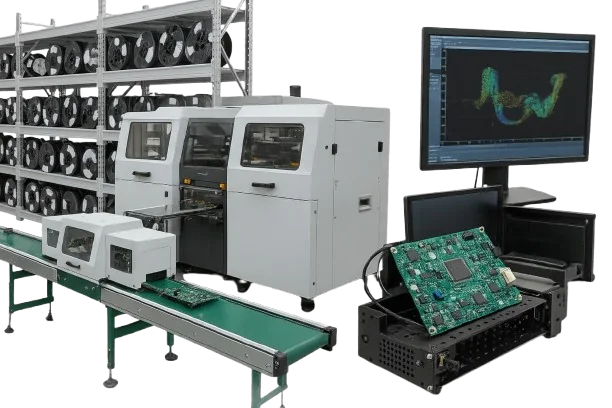
Electronic manufacturing services (EMS) are the contract services a manufacturer provides to build electronic products that another company designed and sells. In electronics, EMS usually covers PCB assembly, component sourcing, inspection and test, and often box build: putting the finished boards into an enclosure with cables, firmware, and packaging. The company whose name is on the product, the original equipment manufacturer (OEM), keeps the design and the brand. The EMS provider supplies the factory, the supply chain, and the process control.
So the electronic manufacturing services definition comes down to this: you bring the design, the EMS provider builds it to your specification. That differs from an original design manufacturer (ODM), which sells you a product it designed, and from a narrow contract manufacturer or assembler that only performs the assembly steps you specify.
This guide answers what is electronic manufacturing services in practice: what EMS stands for in electronics, what EMS providers typically cover, how EMS compares with ODM and CM models, and what to check before you sign with one.
Key takeaways
- EMS stands for electronic manufacturing services (sometimes "electronics manufacturing services"). Related labels include ECM (electronic contract manufacturing) and CEM (contract electronics manufacturer). The labels overlap; the contract scope is what counts.
- A typical EMS scope covers BOM review, component sourcing, PCB assembly, inspection, test, programming, and optionally box build and logistics.
- In the EMS model the OEM owns the design and specifications. In the ODM model the supplier owns or co-owns the design.
- The biggest sources of disputes are unclear ownership of materials, tooling, test programs, and excess inventory. Write them into the contract before the first order.
- Judge an EMS partner by its process evidence for a board like yours: DFM feedback, sourcing controls, inspection and test coverage, and traceability.
What does EMS stand for in electronics?
In electronics, EMS stands for electronic manufacturing services. Companies that provide them are called EMS providers or EMS companies. The term grew from contract assembly: OEMs that once ran their own SMT lines started outsourcing the boards, then the sourcing, then the final product build.
You will see several overlapping acronyms:
| Term | Meaning | How it is usually used |
|---|---|---|
| OEM | Original equipment manufacturer | The company that designs, brands, and sells the product |
| EMS | Electronic manufacturing services | Build-to-print manufacturing plus supply chain and test |
| ECM | Electronic contract manufacturing | Often used as a synonym for EMS |
| CEM | Contract electronics manufacturer | Another synonym, more common in some regions |
| CM | Contract manufacturer | Broad term; in electronics sometimes means a narrower assembly-only service |
| ODM | Original design manufacturer | Designs and builds a product that the customer rebrands |
| JDM | Joint design manufacturer | Co-designs with the customer; ownership is split by contract |
No standard body fixes these labels, so two suppliers using the same acronym can mean different scopes. Read the proposal line by line rather than relying on the label.
What EMS providers cover
An EMS engagement is built from a set of services. Not every project uses all of them.
- Engineering review: DFM and DFA feedback on the PCB and assembly data, test-point review, and engineering queries before release.
- BOM management and sourcing: checking part numbers, lifecycle and availability, proposing alternates, and buying components from approved sources. APT's component sourcing service covers this step.
- PCB fabrication: either in-house or through qualified board suppliers, depending on the EMS provider.
- PCB assembly: SMT and through-hole assembly, with paste inspection, AOI, and X-ray as process gates.
- Programming and test: device programming, flying probe or in-circuit test, functional test, and boundary scan where needed.
- Box build and system integration: mechanical assembly into enclosures, wiring and harnesses, final functional test, labeling, and pack-out. See box build assembly for what that stage includes.
- Logistics and lifecycle support: inventory management, revision control, engineering change orders, and end-of-life component handling.
The common thread is that the EMS provider takes responsibility for building to your specification and proving it with records. Product design, regulatory approval of the product, and market support usually stay with the OEM.
EMS vs ODM vs CM
The choice between models is mostly about who owns the design and how much of the build you want to manage yourself.
| EMS | ODM | CM (assembly-focused) | |
|---|---|---|---|
| Who designs the product | The OEM | The ODM | The OEM |
| Who owns the design IP | The OEM | The ODM, or shared by contract | The OEM |
| Who sources components | Usually the EMS provider (turnkey), or shared | The ODM | Often the OEM supplies parts (consigned) |
| Engineering support | DFM/DFA, test development, process engineering | Full product design | Limited to assembly feedback |
| Typical fit | OEMs with their own design that need production and supply chain | Companies that want a ready-made product to brand | OEMs that manage their own supply chain and want assembly capacity |
| Main risk | Scope gaps if responsibilities are not written down | Design lock-in, limited control over changes | OEM carries more coordination and material risk |
EMS and CM overlap heavily in practice. Many EMS providers will run consigned or partially consigned jobs, and many contract manufacturers source parts. APT's turnkey PCB assembly page lists three supply models (full turnkey, consigned, and hybrid) with responsibility assigned by BOM line in the hybrid case.
Who owns what in an EMS program
This matrix is the most useful thing to agree before the first purchase order. It shows the usual default split for an EMS engagement. Every row can be changed by contract, and the point is to write the answer down.
| Responsibility | OEM (your company) | EMS provider | Must be written into the contract |
|---|---|---|---|
| Product design, schematics, layout | Owns and releases | Reviews for manufacturability | Who approves DFM changes |
| Bill of materials and approved vendor list | Owns the approved parts and alternates | Checks, sources, flags shortages and lifecycle issues | Substitution rules and approval path |
| Component purchasing | Pays for consigned parts | Buys turnkey parts against the approved BOM | Which BOM lines are turnkey, consigned, or hybrid |
| Excess, NCNR, and obsolete stock | Usually liable for parts bought to its forecast | Manages and reports inventory | Liability for excess, minimum-order overbuys, and non-cancellable parts |
| Tooling and fixtures (stencils, pallets, test fixtures) | Usually pays for and owns them | Builds, stores, and maintains them | Ownership and handover on exit |
| Test programs and procedures | Defines what must be tested | Develops and runs the test, records results | Who owns the test software and limits |
| Workmanship standard and acceptance | Sets the class (for example IPC-A-610 Class 2 or 3) | Builds and inspects to it | Acceptance criteria and sampling |
| Traceability and records | Specifies the record level needed | Keeps lot, serial, and process records | Retention period and access |
| Engineering changes | Issues the change | Implements and confirms cut-in | How work-in-progress and stock are handled |
| Product certification (safety, EMC, regulatory) | Owns the product approval | Supplies build records and controls changes that affect it | Notification before any change that could affect the approval |
| Warranty and failure analysis | Handles customer returns | Investigates manufacturing-related failures | Response time and cost split |
APT's turnkey assembly page makes the same point for materials: approved part numbers and sources, alternates, NCNR items, excess material, and ownership are defined before purchasing, not after a shortage.
What is the electronic manufacturing services industry?
The electronic manufacturing services industry ranges from global providers with plants in many countries to regional specialists focused on low-volume, high-mix work. Size matters less than fit. Questions that separate one EMS provider from another:
- Volume and mix. Some lines are set up for long runs of a few products; others for many short runs. Prototypes and NPI favor a high-mix shop.
- Technology. Fine-pitch BGAs, bottom-terminated parts, flex assemblies, or press-fit connectors need specific equipment and experience.
- Supply chain. Access to authorized distribution, shortage handling, and how alternates are approved.
- Sector requirements. Automotive, medical, and industrial programs often require specific quality management certifications and documentation.
- Engineering depth. Whether DFM feedback, test development, and failure analysis are done in-house.
Evaluating an EMS partner
Ask for evidence from a board similar to yours, not a general brochure.
| What to check | Evidence to ask for |
|---|---|
| DFM and engineering review | A sample DFM report or engineering query list on your data |
| Sourcing controls | How parts are sourced, how alternates are approved, how counterfeit risk is handled |
| Process gates | Where SPI, AOI, X-ray, and electrical test sit in the flow for your board |
| Test coverage | Which nets or functions are tested, and with which method |
| First article | A first-article inspection report format and approval step |
| Traceability | What is recorded per lot or serial number, and how long it is kept |
| Quality system | Certifications relevant to your sector, and how corrective actions are handled |
| Change control | How engineering changes and process changes are notified and recorded |
APT, for example, publishes ISO 9001, ISO 13485, and IATF 16949 certification, and its PCBA testing and quality hub maps AOI, flying probe, ICT, FCT, and boundary scan to prototype, NPI, and production stages. Whatever supplier you use, match their certifications and test methods to what your product actually requires.
What to put in an EMS RFQ
A complete RFQ gets you comparable quotes and avoids scope gaps:
- PCB data (Gerber X2, ODB++, or IPC-2581), drill files, stackup, and fabrication drawing
- BOM with manufacturer part numbers, approved alternates, and which lines are consigned
- Placement (centroid) file and assembly drawings
- Workmanship class and any special acceptance criteria
- Test requirements: method, coverage, fixtures, and who supplies the test program
- Programming requirements and firmware version control
- Box build scope if any: mechanical drawings, cables, labeling, packaging
- Quantities: prototype, pilot, and forecast production volumes
- Compliance needs, such as RoHS or sector certifications
- Inventory and excess-material terms you expect
For BOM preparation, the guide to assembly BOM best practices and the article on avoiding BOM mismatch and substitution risk in turnkey PCBA cover the details that most often hold up a quote.
Why work with APTPCB as your EMS provider?
APT combines PCB fabrication, component sourcing, SMT and through-hole assembly, inspection, test, and box build under one contract, and supports full turnkey, consigned, and hybrid supply. The electronic manufacturing services scope is defined in the quotation: sourcing rules, test coverage, workmanship class, and lot documentation are fixed before the order is released. If you are starting from a board design, see how PCB manufacturing and assembly connect for how fabrication and assembly data fit together.
Relevant standards and references may include:
- IPC-A-610: acceptability of electronic assemblies
- IPC J-STD-001: requirements for soldered electrical and electronic assemblies
- IPC/JEDEC J-STD-033: handling of moisture-sensitive devices
- IPC-1782: standard for manufacturing and supply chain traceability of electronic products
- IPC-2581: generic requirements for printed board assembly products manufacturing description data
Frequently asked questions
What does electronic manufacturing services mean?
Electronic manufacturing services are contract services in which a manufacturer builds electronic assemblies or complete products to another company's design. They usually include component sourcing, PCB assembly, inspection, test, and sometimes box build and logistics. The customer keeps the design and brand.
What is the difference between EMS and OEM?
The OEM designs, brands, and sells the product and is responsible for its certification and customers. The EMS provider manufactures the product to the OEM's specification and supplies the factory, supply chain, and build records.
What is the difference between EMS and ODM?
An EMS provider builds a product the customer designed, and the customer owns the design. An ODM designs the product itself and sells it to customers who rebrand it, so the ODM owns or shares the design IP and controls most changes.
Is an EMS provider the same as a contract manufacturer?
Often yes. In electronics, EMS, ECM, and CEM are used almost interchangeably. Some people use "contract manufacturer" for a narrower assembly-only service where the customer supplies the parts. The actual scope depends on the contract, not the label.
What services does an EMS company provide?
Typical services are DFM review, BOM management and component sourcing, PCB fabrication or board procurement, SMT and through-hole assembly, inspection, programming, electrical and functional test, box build, and inventory and change management.
Who owns the tooling and test programs in an EMS contract?
It depends on the contract. Commonly the OEM pays for and owns stencils, fixtures, and test programs, and the EMS provider maintains them. Write ownership and handover terms into the agreement before the first build.
Labels aside, write the scope down
EMS, ECM, CEM, and CM all describe a supplier that builds your design. The label tells you less than the contract does. Decide which model fits how much of the supply chain you want to manage, then fill in the ownership matrix for materials, tooling, tests, records, and changes before the first purchase order.