
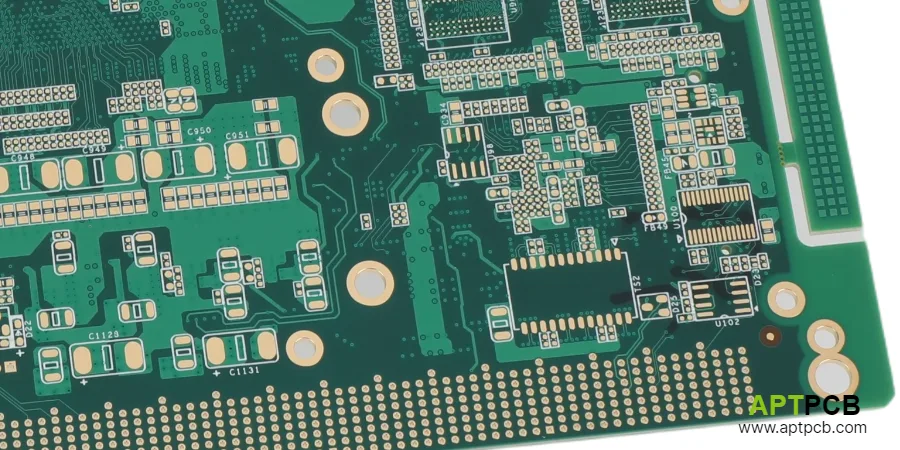
KB-6165 represents the performance center of Kingboard's FR-4 product line. A DICY-free, unfilled, phenolic-cured epoxy resin system with anti-CAF capability, it delivers a typical Tg of 153°C, Td of 348°C, and Z-axis expansion of 3.1% (50–260°C) while meeting IPC-4101B/124 specification requirements. It is one of the most widely specified mid-Tg laminates globally—the material that most PCB designers mean when they specify "mid-Tg FR-4."
KB-6165 spans an enormous family of variants, from the base unfilled grade covered here through filled (KB-6165F), halogen-free (KB-6165G), and mid-loss (KB-6165GMD) versions. Understanding the base material's actual performance is essential for selecting the right variant for your application. This page covers the base KB6165 grade; the filled version has its own KB-6165F datasheet guide.
In This Guide
- KB-6165 Material Technology: Phenolic-Cured DICY-Free Resin
- Verified Datasheet Specifications from Official PDF
- Thermal Reliability: T-260, T-288, and Lead-Free Margins
- Electrical Properties and Impedance Design at 1 GHz
- KB-6165 Family: Seven Variants and How They Relate
- Manufacturing Process and Lamination Parameters
- Target Applications: Telecom, Industrial, Automotive, Medical
- Industry Cross-Reference vs S1000H and IT-158
- KB-6165 vs KB-6165F vs KB-6165G
- How to Order KB-6165 PCBs from APTPCB
KB-6165 Material Technology: Phenolic-Cured DICY-Free Resin with Anti-CAF
KB-6165 uses a non-DICY (dicyandiamide-free) phenolic-cured epoxy resin system reinforced with E-glass fabric. The non-DICY cure is significant: traditional DICY curing agents decompose at elevated temperatures, releasing moisture and nitrogen gas that can cause blistering and delamination during lead-free reflow. The phenolic cure mechanism avoids these byproducts entirely, resulting in cleaner thermal profiles during multiple assembly passes.
The resin system is unfilled—no inorganic filler particles are added. This keeps the dielectric constant slightly lower than filled variants (KB-6165F) and provides standard drill tool life, but results in somewhat higher Z-axis CTE compared to the filled version.
KB-6165 is explicitly designed with anti-CAF (Conductive Anodic Filament) resistance, rated at ≥1000 hours under 85°C/85% RH with 50V DC bias. This electrochemical failure mode becomes increasingly important as pitch dimensions shrink below 0.5 mm.
KB-6165 Verified Datasheet Specifications from Official Kingboard PDF
All values sourced from Kingboard's official KB-6165 product datasheet. Specimen thickness: 1.6 mm (8×7628 construction).
Thermal and General Properties
| Test Item | Test Method (IPC-TM-650) | Condition | Spec (IPC-4101B/124) | Typical Value |
|---|---|---|---|---|
| Thermal Stress | 2.4.13.1 | Float 288°C, Unetched | ≥10 sec | 60 sec |
| Glass Transition (Tg) | 2.4.25 | E-2/105, DSC | ≥150°C | 153°C |
| Z-axis CTE Alpha 1 (below Tg) | 2.4.24 | TMA | ≤60 ppm/°C | 55 ppm/°C |
| Z-axis CTE Alpha 2 (above Tg) | 2.4.24 | TMA | ≤300 ppm/°C | 287 ppm/°C |
| Z-axis Expansion (50–260°C) | 2.4.24 | TMA | ≤3.5% | 3.1% |
| T-260 | 2.4.24.1 | TMA | ≥30 min | 50 min |
| T-288 | 2.4.24.1 | TMA | ≥5 min | 23 min |
| Td (5% weight loss) | 2.4.24.6 | TGA | ≥325°C | 348°C |
| CAF Resistance | — | 85°C/85%RH, 50V DC | ≥1000 h | 1000 h |
| Flammability | UL94 | E-24/23 | V-0 | V-0 |
Electrical Properties
| Test Item | Test Method | Condition | Spec | Typical Value |
|---|---|---|---|---|
| Surface Resistivity | 2.5.17.1 | C-96/35/90 | ≥1.0×10⁴ MΩ | 1.0×10⁷ MΩ |
| Volume Resistivity | 2.5.17.1 | C-96/35/90 | ≥1.0×10⁶ MΩ·cm | 1.0×10⁹ MΩ·cm |
| Dielectric Breakdown | 2.5.6 | D-48/50+D0.5/23 | ≥40 kV | 48 kV |
| Dielectric Constant (Dk) @ 1 MHz | 2.5.5.2 | Etched | ≤5.4 | 4.5 |
| Dissipation Factor (Df) @ 1 MHz | 2.5.5.2 | Etched | ≤0.035 | 0.018 |
| Arc Resistance | 2.5.1 | D-48/50+D0.5/23 | ≥60 sec | 125 sec |
Mechanical Properties
| Test Item | Test Method | Condition | Spec | Typical Value |
|---|---|---|---|---|
| Peel Strength (1 oz) | 2.4.8 | 125°C | ≥0.70 N/mm | 1.35 N/mm |
| Peel Strength (1 oz) | 2.4.8 | Float 288°C/10 sec | ≥1.05 N/mm | 1.42 N/mm |
| Flexural Strength (Warp) | 2.4.4 | — | ≥415 N/mm² | 560 N/mm² |
| Flexural Strength (Fill) | 2.4.4 | — | ≥345 N/mm² | 430 N/mm² |
| Moisture Absorption | 2.6.2.1 | D-24/23 | ≤0.35% (min 0.51mm) / ≤0.80% (max 0.51mm) | 0.16% / 0.30% |
Laminate Availability
- Base Color: Yellow
- Thickness: 0.05 mm–3.2 mm
- Copper Cladding: 18 µm (½ oz), 35 µm (1 oz), 70 µm (2 oz), 105 µm (3 oz)
- Standard Panel Sizes: 37"×49" (940×1245mm), 41"×49" (1042×1245mm), 43"×49" (1093×1245mm)
Thermal Reliability Analysis: T-260, T-288, and Lead-Free Reflow Margins
The T-260 value of 50 minutes and T-288 of 23 minutes are the critical numbers for assembly process engineers. For a typical lead-free SMT profile peaking at 250°C for 60–90 seconds, the T-260 of 50 minutes provides roughly 30× margin over a single reflow pass. Even with double-sided SMT (2 passes), selective wave soldering, and rework, KB-6165 offers adequate thermal budget for most commercial assembly scenarios.
However, the T-288 of 23 minutes warrants careful analysis for complex assemblies. Each reflow pass at 260°C peak represents approximately 30–45 seconds above 288°C. For boards requiring 5+ reflow passes or extended rework at high temperatures, the cumulative time at >288°C must be tracked against this 23-minute budget. If your process approaches this limit, upgrading to KB-6167F (T-288 >35 minutes typical) provides additional margin.
The Z-axis expansion of 3.1% (50–260°C) is the primary differentiator between KB-6165 and filled alternatives. On a 1.6 mm board, 3.1% translates to approximately 50 µm of total Z-axis movement. For comparison, KB-6165F (filled) achieves 3.0% and KB-6167F achieves 2.6%. The 16% improvement from KB-6165 to KB-6167F translates directly to extended via cycling life—typically 30–50% more thermal cycles before via failure.
The Alpha 1 CTE of 55 ppm/°C (below Tg) versus Alpha 2 of 287 ppm/°C (above Tg) shows the dramatic CTE change at Tg. Since the board operates below Tg during normal use, the 55 ppm/°C Alpha 1 value determines dimensional behavior during temperature cycling in the field. The Alpha 2 value only matters during assembly reflow when temperature exceeds Tg.
Electrical Properties and Impedance Design Implications at 1 GHz
KB-6165's Dk of 4.5 at 1 MHz (from the official datasheet) and Df of 0.018 at 1 MHz place it squarely in standard FR-4 territory. Note that the datasheet reports values at 1 MHz, not 1 GHz. At GHz frequencies, Dk typically decreases slightly and Df increases—a characteristic of all FR-4 materials.
For impedance-controlled designs, the key insight is that the actual Dk depends heavily on the prepreg resin content and glass style. A 2116 prepreg at 50% R/C will have a different Dk than 7628 at 44% R/C. Use prepreg-specific Dk values in the impedance calculator rather than the laminate-level Dk, which represents a specific 8×7628 construction.
The Df of 0.018 at 1 MHz makes KB-6165 suitable for digital designs operating below approximately 3 GHz. For USB 3.0 (5 Gbps), SATA III (6 Gbps), or PCIe Gen 3 (8 GT/s) with trace lengths under 4 inches, KB-6165 typically provides adequate signal quality. For longer traces or faster interfaces, consider KB-6165GMD (Df ~0.010) or KB-6167GLD (Df ~0.006).
The peel strength values—1.35 N/mm at 125°C and 1.42 N/mm after float at 288°C—significantly exceed specification minimums. The after-float peel strength is actually higher than the hot peel strength, indicating excellent resin-to-copper adhesion that improves with the post-cure effect of thermal exposure.
KB-6165 Family Variant Map: Seven Products and How They Relate
KB-6165 serves as the base platform for Kingboard's most extensive material family:
| Variant | Key Difference | IPC Slash | Filled | Halogen-Free | Primary Application |
|---|---|---|---|---|---|
| KB-6165 | Base, unfilled | /124 | No | No | Standard multilayer 4–12L |
| KB-6165F | Filled, lower CTE | /99 | Yes | No | High layer count, BGA |
| KB-6165C | Alt HF chemistry | — | No | Yes | OEM-specific approvals |
| KB-6165LE | Low expansion | — | No | No | Extended thermal cycling |
| KB-6165G | Halogen-free | — | No | Yes | EU/automotive compliance |
| KB-6165GC | HF, lower Dk | — | No | Yes | HF + better SI |
| KB-6165GMD | Mid-loss | — | No | Yes | 1–10 Gbps digital |
This breadth means engineers can prototype on KB-6165 and migrate to a variant without redesigning the stackup—all variants share similar mechanical dimensions.
Manufacturing Process Guidelines and Lamination Parameters
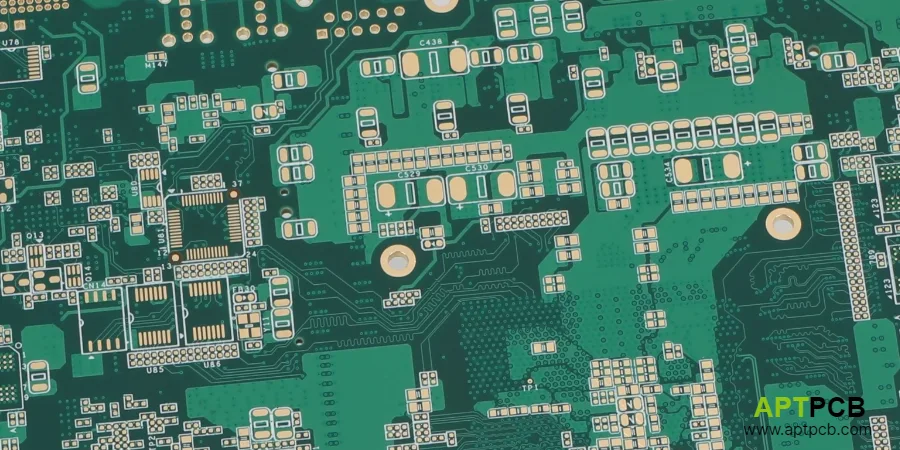
KB-6165 is specified for applications in computers and peripherals, communication equipment, instruments, and OA equipment. At APTPCB, we process it on our standard multilayer PCB manufacturing line with parameters optimized from Kingboard's guidelines.
Drilling: As an unfilled material, KB-6165 offers standard drill tool life—approximately 3,000–5,000 hits for 0.25–0.40 mm vias depending on board thickness. This is 15–20% better than filled alternatives like KB-6165F. For HDI microvia structures, UV or CO₂ laser drilling produces clean via barrels.
Surface Finishes: All standard finishes are compatible: HASL (Sn/Pb and lead-free), ENIG, OSP, immersion silver, and immersion tin. For boards requiring fine-pitch BGA assembly, ENIG provides the flattest surface.
Quality Control: Our quality system includes TDR impedance testing, AOI, and full electrical test (flying probe or fixture) on every production order. First-article microsection analysis verifies via quality and dielectric thickness. Innerlayer registration accuracy of ±2 mil is maintained across all layer counts.
Target Applications: Telecom, Industrial, Automotive, and Medical PCBs
Telecommunications: Base station controllers, network switches, and optical transport equipment with 10-year service life. The anti-CAF capability is critical for fine-pitch connectors in outdoor cabinets exposed to humidity cycling. Our telecom PCB services include controlled impedance and backdrilling.
Industrial Controls: PLCs, motor drives, and power conversion modules operating from -20°C to +85°C ambient. The 560 N/mm² flexural strength prevents warpage under heavy connector and heatsink loads. Standard FR-4 PCB fabrication processes apply.
Automotive (Non-ADAS): Body electronics, lighting controllers, and infotainment processing boards. For automotive PCB requirements, APTPCB provides PPAP documentation and lot-level material traceability. Note: for under-hood applications or ADAS requiring extended thermal cycling, upgrade to KB-6167F.
Medical Instruments: Diagnostic equipment and patient monitoring systems. The DICY-free cure system provides cleaner outgassing—advantageous for sensitive sensor proximity.
Consumer Electronics: High-volume products requiring lead-free assembly at competitive cost. KB-6165 represents the optimal balance of reliability and economics for products sold into regulated markets.
Industry Cross-Reference: KB-6165 vs Shengyi S1000H and ITEQ IT-158
| Parameter | KB-6165 | Shengyi S1000H | ITEQ IT-158 | Isola IS410 |
|---|---|---|---|---|
| Tg (DSC) | 153°C | 150°C | 150°C | 150°C |
| Td (TGA) | 348°C | 340°C | 340°C | 340°C |
| Dk @ 1 MHz | 4.5 | 4.5 | 4.4 | 4.4 |
| Df @ 1 MHz | 0.018 | 0.016 | 0.016 | 0.013 |
| Z-CTE (50–260°C) | 3.1% | 2.8% | 2.8% | 3.0% |
| T-260 (typical) | 50 min | >30 min | >30 min | >30 min |
| T-288 (typical) | 23 min | >15 min | >15 min | >15 min |
| IPC Slash Sheet | /124 | /99 or /124 | /99 | /21 or /26 |
| Filled | No | Variants | No | No |
KB-6165 is typically the most cost-competitive option due to Kingboard's production scale. The Z-CTE of 3.1% is slightly higher than some competitors—for designs requiring lower expansion, consider KB-6165F (3.0%) or KB-6167F (2.6%). APTPCB processes all major brands and advises on the most cost-effective option. For datasheets from other PCB material manufacturers, see our materials library.
KB-6165 vs KB-6165F vs KB-6165G: Which Variant Fits?
The three grades most often compared are the base material, the filled version and the halogen-free version. Values are from the Kingboard datasheets summarized in the Kingboard laminate selection guide:
| Property | KB-6165 | KB-6165F | KB-6165G |
|---|---|---|---|
| Resin | Unfilled, phenolic cure | Filled | Halogen-free |
| Tg (DSC) | 153°C | 157°C | 155°C |
| Z-axis expansion (50–260°C) | 3.1% | 3.0% | 2.8% |
| Anti-CAF | Yes | Yes | Yes |
| Drill tool life | Standard | 15–20% shorter (filler) | Check with fabricator |
| Pick it when | General mid-Tg multilayer, lead-free assembly | High layer count, large BGAs, via reliability first | Halogen-free compliance is required |
If your drawing calls out "Tg 150 FR-4" without a grade, any of these, or an equivalent from another brand, can meet it. Name the variant when filled resin or halogen-free matters to your design. For non-FR-4 options such as metal core or package substrates, see the PCB substrate selection guide.
How to Order KB-6165 PCBs from APTPCB
APTPCB maintains KB-6165 inventory in standard core thicknesses from 0.1 mm to 1.6 mm with all common copper weights. Submit your Gerber files and stackup specification for a free DFM review including material verification, impedance simulation, and competitive pricing.
For one-stop PCB fabrication and assembly, we quote both services together with optimized lead times. Mass production runs benefit from dedicated KB-6165 inventory with no material lead-time delay.