
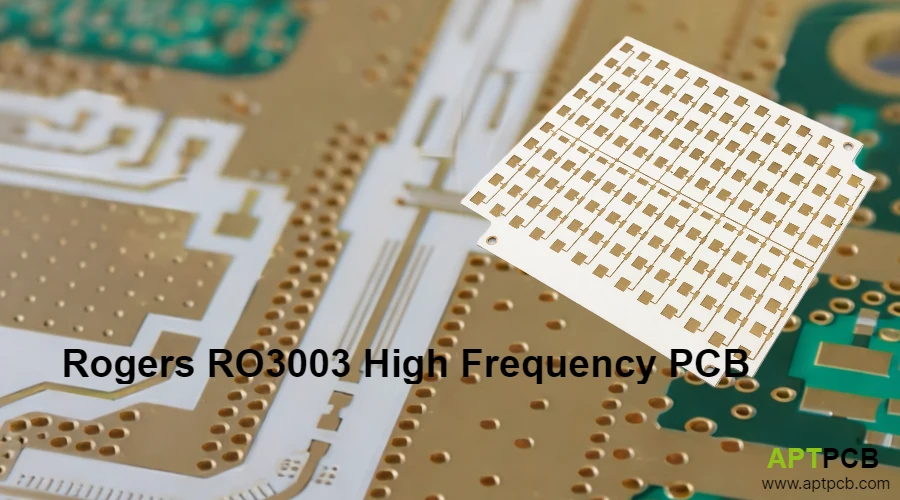
The question isn't whether Rogers RO3003 is a better substrate than FR-4. At millimeter-wave frequencies, it's not a comparison—FR-4 simply doesn't work. The more useful question, and the one that actually drives PCB material selection decisions, is: at what point does a design cross the threshold where Rogers RO3003 becomes necessary rather than merely preferable?
That threshold is not a single frequency number. It depends on trace lengths, insertion loss budget, temperature range, Dk stability requirements across production lots, and whether the design includes phase-coherent antenna structures. This guide provides a decision framework grounded in material physics, not marketing specs—so engineers can answer the question for their specific application.
What "High-Frequency" Actually Means for Substrate Selection
The term "high-frequency PCB" is used to describe everything from a 1GHz power amplifier board to a 94GHz automotive radar front end. The substrate requirements for those two designs are separated by several orders of magnitude in difficulty.
Substrate selection for high-frequency applications is driven by three distinct failure modes that emerge as frequency increases:
Dielectric loss accumulation. Every millimeter of trace on a lossy substrate dissipates signal energy as heat. The dissipation factor (Df) determines how much is lost per unit length. At 1GHz, FR-4's Df of ~0.020 produces manageable losses over short traces. At 77GHz, the same Df value produces losses so severe that the entire link budget is consumed before the signal reaches the antenna elements. RO3003's Df of 0.0010 is twenty times lower.
Dk instability across conditions. Phased-array antennas require all element feed paths to arrive in phase. Phase velocity is proportional to 1/√Dk. If Dk drifts with temperature, frequency, or board-to-board variation, element paths arrive out of phase and beam-steering accuracy degrades. FR-4's Dk varies by ±10% or more across manufacturing lots and temperatures. RO3003's Dk is 3.00 ± 0.04—controlled by ceramic loading in the PTFE matrix.
Conductor loss from surface roughness. At high frequencies, the skin effect confines current to the outermost few micrometers of the conductor surface. Rough copper foil forces this current to follow a longer effective path, adding conductor loss. This effect is proportional to frequency and becomes significant above roughly 10GHz. At 77GHz, standard electrodeposited copper adds 30–40% more conductor loss than low-profile copper on the same trace geometry.
Understanding which of these three failure modes is active in a given design determines which substrate is actually required. The fundamental electrical and mechanical properties of Rogers RO3003—Dk 3.00 ± 0.04, Df 0.0010, TcDk −3 ppm/°C—establish the baseline against which FR-4 and intermediate materials are compared.
The Substrate Decision Matrix by Frequency Range
The following framework reflects where the three failure modes become design-limiting:
Below 6GHz: Standard FR-4 Is Viable
At frequencies up to roughly 6GHz, FR-4's Df of ~0.020 produces acceptable insertion loss over trace lengths typical of commercial electronic designs (inches, not feet). Dk variation across FR-4 lots is inconvenient but manageable for most non-phased-array architectures. Conductor loss from surface roughness is small relative to total loss.
Standard FR-4 is appropriate for: cellular baseband processing, 2.4GHz and 5GHz Wi-Fi, Bluetooth, and sub-6GHz LTE/NR radio units that don't have demanding insertion loss budgets.
Exception: If the design requires phase-matched paths across a large array at any frequency, or if the operating temperature range spans more than 50°C with a tight Dk tolerance requirement, these constraints can push the substrate requirement to a higher-performance material even below 6GHz.
6–18GHz: Hydrocarbon-Ceramic Materials (RO4350B, RO4003C) Are Often Sufficient
In the 6–18GHz range—X-band (8–12GHz) radar, Ku-band (12–18GHz) satellite downlinks, and C-band (4–8GHz) communication systems—hydrocarbon-ceramic materials like Rogers RO4350B (Dk 3.48, Df 0.0037) or RO4003C (Dk 3.38, Df 0.0027) provide substantially lower loss than FR-4 while processing similarly to FR-4 in most fabrication shops. They don't require PTFE-specific vacuum plasma desmear or modified drilling parameters.
When RO3003 is still required in this range:
- Automotive-grade qualification (IATF 16949) with long thermal cycling life. RO4350B's thermoset chemistry behaves differently under thousands of thermal cycles than RO3003's ceramic-loaded PTFE.
- Phase-coherent arrays where the tighter Dk tolerance of RO3003 (±0.04 vs. ±0.05 for RO4350B) matters at scale.
- Designs that must share a stackup with 77GHz outer layers on the same board—using the same material throughout simplifies fabrication and quality control.
Above 20GHz: Rogers RO3003 Becomes the Standard Choice
Above roughly 20GHz, the three failure modes described above operate simultaneously, and their combined effect becomes design-limiting:
The dielectric loss formula establishes the threshold clearly:
Loss (dB/inch) ≈ 2.3 × f(GHz) × √Dk × Df
At 77GHz with RO3003 (Df = 0.0010, Dk = 3.00): ~0.31 dB/inch
At 77GHz with RO4350B (Df = 0.0037, Dk = 3.48): ~1.17 dB/inch
At 77GHz with FR-4 (Df ≈ 0.020, Dk ≈ 4.2): ~6.2 dB/inch
On a 3-inch antenna feed network, those differences become 0.9 dB, 3.5 dB, and 18.6 dB respectively. The FR-4 case is non-functional. The RO4350B case may or may not close the link budget depending on system gain. The RO3003 case leaves margin for connector losses, component tolerances, and manufacturing variation.
This is the design space where Rogers RO3003 high-frequency PCBs are not just preferred—they are the engineered solution. Primary applications include: 24GHz and 77GHz automotive radar, 28GHz and 39GHz 5G NR mmWave, 60GHz WiGig and industrial sensing, Ka-band (26.5–40GHz) satellite uplinks, and W-band (75–110GHz) imaging and test systems.
How RO3003's Material Properties Solve High-Frequency Design Problems
Dk Stability: The Phase Coherence Enabler
Rogers RO3003's Dk of 3.00 ± 0.04 is achieved through controlled ceramic loading in the PTFE matrix. The ceramic micro-particles stabilize the polymer against both temperature-driven Dk shifts and lot-to-lot manufacturing variation.
The thermal coefficient of Dk (TcDk) is −3 ppm/°C over the range −50°C to +150°C. Across the −40°C to +85°C automotive operating range (125°C swing), RO3003's Dk changes by:
ΔDk = 3.00 × (−3 × 10⁻⁶ ppm/°C) × 125°C = 0.001125
This is effectively zero in any practical antenna simulation. Materials with TcDk values of 50–100 ppm/°C produce Dk shifts that require active temperature compensation algorithms in the radar processor—adding firmware complexity and a potential failure mode. RO3003 eliminates the need for compensation entirely.
Df 0.0010: What Twenty Times Better Means in Practice
The dissipation factor is not just a material specification. It is a direct input to the system link budget. In a 77GHz collision-avoidance radar with a 3-inch transmit feed network, the choice between Df 0.020 (FR-4) and Df 0.0010 (RO3003) is the difference between 18.6 dB and 0.9 dB of feed loss. That 17.7 dB recovered from the link budget can be traded for: lower RFIC transmit power (lower cost, less heat), longer detection range (better safety margin), or reduced receive-path amplification (fewer LNA stages, lower NF).
CTE Matching: Protecting Fine Geometries Through Thermal Cycles
RO3003's X/Y CTE of 17/16 ppm/°C closely matches copper's ~17 ppm/°C. This means that as the board moves through automotive thermal cycles (−40°C to +125°C), the substrate and copper traces expand and contract together. RF trace widths—which directly control impedance—stay consistent through the life of the vehicle.
The Z-axis CTE of 24 ppm/°C is also well-controlled relative to pure PTFE (which can exceed 200 ppm/°C without ceramic loading). This controlled Z-axis expansion is the reason IPC Class 3 plating to 25 μm via copper is achievable and maintainable on RO3003—where pure PTFE would fracture via barrels within the first assembly reflow. The fabrication process requirements for RO3003 explain in detail how ceramic loading makes reliable via plating possible.
RO3003 vs. RO4350B: The Decision at the Boundary
The most common substrate selection question isn't FR-4 vs. RO3003—that question is easy. The harder question is RO4350B vs. RO3003 in the 10–30GHz range where both materials are technically viable.
| Parameter | RO4350B | RO3003 | Decision Driver |
|---|---|---|---|
| Dk | 3.48 ± 0.05 | 3.00 ± 0.04 | Dk tolerance matters for phase arrays; lower Dk gives wider traces |
| Df @ 10GHz | 0.0037 | 0.0010 | Df drives feed network insertion loss |
| TcDk | +50 ppm/°C | −3 ppm/°C | Thermal stability: RO3003 significantly better |
| CTE (X/Y) | 14/16 ppm/°C | 17/16 ppm/°C | RO3003 matches copper more closely on X-axis |
| Lamination process | Thermoset, FR-4-like | PTFE, requires plasma desmear | RO4350B simpler to fabricate |
| Fabricator availability | Broad | Limited to PTFE-capable shops | More suppliers available for RO4350B |
| Automotive IATF reliability | Good | Excellent | Both viable; RO3003 preferred above 24GHz |
The practical decision boundary: If the operating frequency is consistently above 20GHz, or if the automotive temperature reliability requirement spans 1,000+ thermal cycles with tight impedance stability, RO3003 is the better-founded choice. At 10–18GHz with non-automotive reliability requirements, RO4350B is often the more cost-efficient selection given its wider fabricator availability.
For programs that combine both frequency ranges in a single board—a radar SoC that generates 77GHz RF and processes baseband digitally on the same PCB—the Rogers RO3003 custom PCB stackup guide covers how to architect a hybrid stackup that places each material where its properties are actually required.
Fabrication Implications of High-Frequency Substrate Selection
Selecting Rogers RO3003 for a high-frequency PCB changes the fabrication requirements substantially relative to FR-4 or hydrocarbon-ceramic materials. The key differences:
Vacuum plasma desmear is mandatory. PTFE's surface energy of ~18 dynes/cm makes standard alkaline permanganate wet desmear ineffective. CF₄/O₂ plasma activation is required to prepare PTFE via walls for copper plating. A fabricator without in-house plasma capability cannot build a reliable RO3003 board—and cannot outsource this step without breaking process traceability.
Modified drilling parameters. PTFE softens under heat. Standard FR-4 drilling speeds melt the material before the drill exits the hole. Reduced spindle speeds (60,000–80,000 RPM vs. 120,000–150,000 RPM for FR-4) are required, with hit counts limited to under 500 per bit due to ceramic abrasion.
Low-profile copper foil must be specified at laminate order time. At 77GHz, conductor loss from surface roughness becomes significant. Low-profile ED copper (Ra ≈ 1.5 μm) must be specified as part of the laminate procurement—it cannot be corrected after the fact.
These requirements eliminate most general-purpose PCB fabricators from consideration. The RO3003 PCB manufacturer qualification checklist identifies the specific equipment and documentation that separate a genuinely capable PTFE fabricator from one claiming the capability on a website.
Copper Foil Profile: The High-Frequency Detail Most Designers Miss
At frequencies above 30GHz, the skin effect depth in copper is approximately 0.24 μm at 77GHz. Standard electrodeposited copper has RMS surface roughness of 5–7 μm—meaning the current-carrying surface is many times rougher than the effective conductor depth. The result is 30–40% additional conductor loss compared to a smooth surface.
For any high-frequency PCB program operating above 30GHz, copper foil profile is a design specification that must be called out in the laminate order—not assumed. APTPCB sources RO3003 pre-laminated with low-profile ED copper (Ra ≈ 1.5 μm) or Reverse Treated Foil (RTF) for mmWave programs. The specification choice happens during laminate procurement; it cannot be changed at the fabrication stage.
This is a common source of insertion loss margin errors in first-prototype builds: the EM simulation assumes ideal or smooth copper, the fabricator uses standard-profile copper by default, and the measured hardware shows 20–30% more feed loss than simulated. Specifying copper foil profile explicitly closes this gap.
From High-Frequency Selection to Production
Choosing Rogers RO3003 for a high-frequency PCB program is the beginning of a fabrication and supply chain process that is materially different from standard PCB procurement. Rogers Corporation is the sole manufacturer of RO3003 laminate, and raw material delivery from order is 8–12 weeks. Fabricators that pre-stock common core thicknesses can deliver prototypes in 3–4 weeks; those who order per job cannot.
The RO3003 PCB quick-turn guide covers material stock availability, the DFM front-loading steps that determine whether the 3–4 week window holds, and how to sequence Immersion Silver shelf life against SMT assembly scheduling.
For programs at the evaluation stage—still comparing substrate options before committing to Gerber generation—APTPCB's engineering team can provide DFM-informed stackup modeling to confirm whether a specific design crosses the threshold where RO3003's properties are genuinely required, or whether a lower-cost material can close the link budget.